Its Hard to Forget Someone Who Gave Us: Graphics for Crafts & Heartfelt Branding
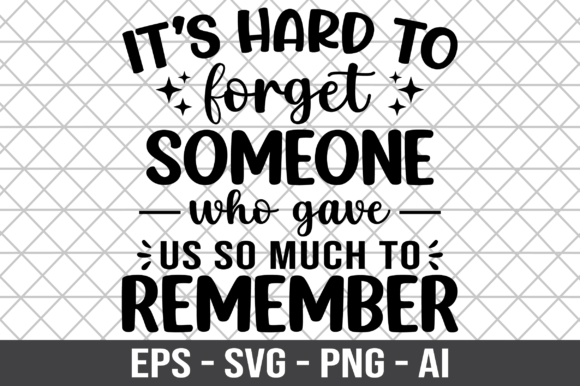
As a graphic designer who’s built brand identities for handmade businesses, seasonal Etsy shops, and boutique print-on-demand lines, I opened Its Hard to Forget Someone Who Gave Us expecting sentiment—but what stood out immediately was its quiet design intelligence. It’s not overly ornate, nor is it sterile; instead, it strikes that rare balance between warmth and precision—a hand-drawn elegance with clean vector integrity. The phrase feels tender but grounded, ideal for clients whose storytelling centers on gratitude, legacy, or personal connection: think artisanal candle labels, memorial stationery, teacher appreciation kits, or small-batch gift box inserts.
A Mood That Anchors, Not Distracts
This isn’t decorative clipart—it’s a graphic design asset with emotional weight and visual restraint. The lettering leans into soft serif or gentle script territory (though it’s fully vector-based), with subtle texture and intentional spacing that invites pause. It reads as timeless rather than trendy, making it unusually versatile across creative design contexts—from Instagram carousel graphics for a local florist’s “thank you” campaign to printable wall art for a wellness coach’s client welcome kit. Its strength lies in how it supports narrative without shouting over it.
Where It Shines in Real Client Work
- Product mockups: Stands beautifully on kraft paper packaging, ceramic mug renders, and linen tote bag previews—especially when paired with muted palettes or natural textures.
- Social media graphics: Works powerfully in Pinterest pins and Instagram Stories where emotional resonance drives engagement. The transparent PNG drops cleanly onto photo backgrounds; the SVG scales flawlessly for animated Canva templates.
- Cricut projects & printable design: The vector files hold crisp edges at any size—ideal for vinyl decals, iron-on transfers, or layered scrapbook sheets. No pixelation, no jagged curves.
- Packaging design & brand identity: Functions elegantly as a secondary typographic element—think bottom-corner emboss on a soap label or foil-stamped detail inside a greeting card. It deepens brand consistency without competing with primary logos.
- Editorial and web design: Adds sincerity to blog headers, newsletter sign-up banners, or “About Us” section accents—particularly effective for mission-driven small business branding.
Where Caution Is Warranted
Its Hard to Forget Someone Who Gave Us doesn’t perform equally well everywhere. Avoid using it at under 24pt in dense layouts—its delicate strokes lose clarity next to bold sans-serif body copy or busy photography. It’s also not suited for minimalist corporate materials (think law firm brochures or SaaS dashboard UI) where neutrality and scalability trump expressiveness. On low-contrast backgrounds—like light gray text over off-white—the transparency in the PNG can blur readability. And while it complements handwritten fonts beautifully, pairing it with ultra-thin display fonts risks visual imbalance.
Design Judgment in Action: A Real Project Example
Last month, I developed a holiday collection for a family-run ceramics studio launching their first line of keepsake mugs. Their audience values authenticity, craftsmanship, and quiet meaning—not flash. We needed marketing visuals that felt personal, not promotional. Its Hard to Forget Someone Who Gave Us became the emotional anchor: resized and centered on a matte black mug mockup, then echoed in a subtle watermark across their email header and product tags. It elevated the entire campaign—not by being loud, but by reinforcing trust and intentionality. Clients responded with comments like “This feels like it was made *for* me.” That’s the mark of strong commercial design.
Practical Designer Notes Before You Use It
- Test the transparent PNG against both light and dark backgrounds—some exports retain faint anti-aliasing halos that affect contrast.
- Preview the SVG in your vector editor: confirm all paths are clean, grouped logically, and editable (no embedded raster elements).
- Check licensing explicitly—even if labeled “commercial use,” verify whether resale in digital products (e.g., Canva template bundles or Cricut project packs) is permitted.
- Print a test sheet at multiple sizes: look for ink bleed on fine strokes, especially if planning sublimation design or screen printing.
- Compare legibility alongside your brand’s core typefaces—does it harmonize with your serif headlines? Does it create unwanted rhythm breaks next to your sans-serif body copy?
- Run a black-and-white conversion: ensure emotional tone holds without color support—critical for sticker design or monochrome packaging.
Why This Fits the Creative Marketplace—and Your Workflow
In a sea of generic quote graphics, Its Hard to Forget Someone Who Gave Us stands out because it’s both emotionally precise and technically sound. It’s not just another SVG design or PNG design—it’s a thoughtfully crafted piece of creative marketplace output that understands context. For crafters building Etsy products, marketers designing heartfelt campaigns, or designers sourcing reliable design assets, this delivers more than convenience: it delivers cohesion. When paired with smart layout decisions, appropriate typography, and intentional color application, it becomes part of the story—not just decoration.
The Bottom Line for Professional Use
If your client project hinges on sincerity, memory, or human-centered messaging—whether it’s a handmade business launch, a print-on-demand collection, a seasonal social media push, or a boutique packaging refresh—Its Hard to Forget Someone Who Gave Us earns its place in your working toolkit. It’s not a one-size-fits-all solution, but in the right context, it adds polish, personality, and quiet professionalism. Just remember: great digital product integration starts with thoughtful testing—not just dragging and dropping. Verify file integrity, validate licensing, and always preview in real-world conditions. That’s how you turn a simple graphic into meaningful marketing visuals.